Starting an LLC in North Carolina can feel overwhelming when it is your first business. But the process becomes much easier once you separate the required filings from the optional services.
There are seven main steps: choose your name, appoint a registered agent, file your Articles of Organization, get an EIN, write an operating agreement, open a business bank account, and keep your LLC active. Along the way, I’ll explain what I would choose, why I would choose it, and what each option costs.
A quick note on pricing: The amounts below reflect the filing and service options shown in this walkthrough. Confirm current fees and renewal terms before paying.
Disclosure: Some links are affiliate links. If you purchase through them, we may earn a small commission at no extra cost to you.
What You'll Learn
- Check state name availability, potential trademark conflicts, and matching online identities before filing.
- Separate required filing costs from optional services and future renewal charges.
- Keep formation documents, an EIN, an operating agreement, and business banking organized.
- Plan for North Carolina’s April 15 annual report deadline and any business-specific licensing requirements.
Table of Contents
- Step 1: Choose Your North Carolina LLC Name
- Step 2: Choose Your Registered Agent
- Step 3: File Your Articles of Organization
- Step 4: Get Your EIN
- Step 5: Write Your Operating Agreement
- Step 6: Open a Business Bank Account
- Step 7: Keep Your North Carolina LLC Active
- Your North Carolina LLC Setup Checklist
Step 1: Choose Your North Carolina LLC Name
Before you pay for anything, make sure the business name you want is available. A rejected name means extra work before your LLC can move forward.
Keep these three basic rules in mind:
- Include an LLC designation. A straightforward choice is to end the name with “LLC” or spell out “Limited Liability Company.”
- Avoid misleading or restricted wording. Your name should not make the business sound like a government agency or a bank.
- Choose a distinguishable name. A name that is already taken, or too close to an existing business name, can lead to rejection.
Search North Carolina’s business records
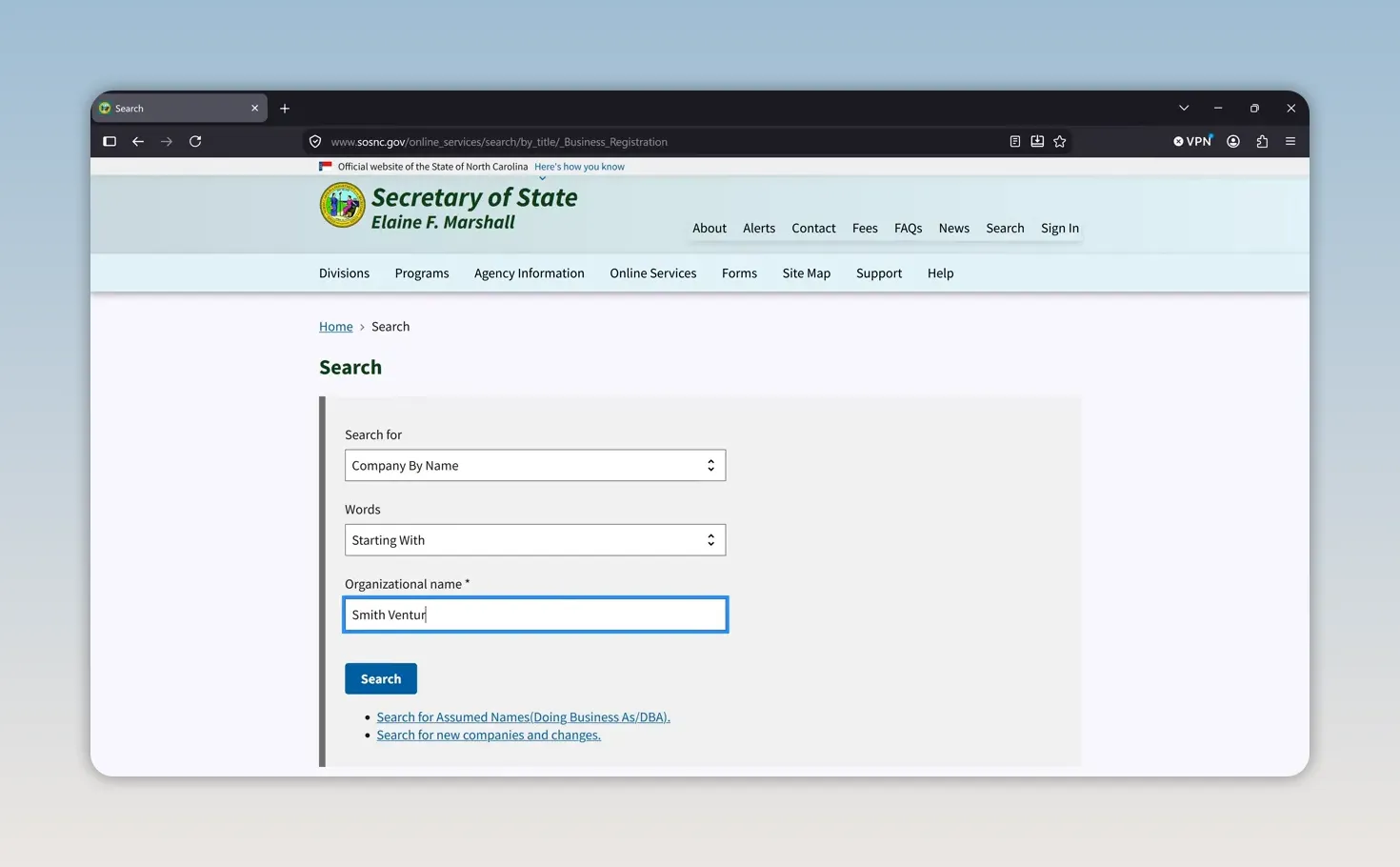
Use the free North Carolina Secretary of State business search. You do not need to create an account.
- Set the search method to Starting With.
- Enter your proposed business name.
- Run the search and review the existing businesses.
If your name looks very similar to something already registered, I would choose a different one rather than risk having the filing sent back.
Check trademarks, domains, and social handles
The state business search is only one check. Run a separate search through the USPTO trademark search tool to look for potential trademark conflicts. State name availability does not, by itself, resolve trademark issues.
Then check the domain name and social media handles you want. Ideally, your business name, website address, and social accounts will match. It is much easier to work this out now than after you have filed.
Step 2: Choose Your Registered Agent
Every North Carolina LLC needs a registered agent. This is the official contact who receives legal mail for the business at a real street address in North Carolina during business hours.
You have two main options.
Option 1: Be your own registered agent
Acting as your own registered agent avoids a service fee. The trade-off is privacy and availability: your registered agent information becomes public, and you need to be available at the listed address during business hours.
If you use your home address, that puts your home address in public business records. For a home-based business, that is an important consideration.
Option 2: Use a registered agent service
I would personally use a service. For this walkthrough, I’m using Northwest Registered Agent because it combines filing assistance with registered agent service and address options.
The formation offer includes the first year of registered agent service. After that, the registered agent service renews at $125 per year.
One important detail: appointing a registered agent does not automatically replace every address on your LLC filing. You still need to review the business physical and mailing address fields before the paperwork is submitted. We will cover that in the next step.
Step 3: File Your Articles of Organization
The document that forms your North Carolina LLC is called the Articles of Organization. It is filed with the North Carolina Secretary of State.
You can file directly through the state or have a formation service handle it:
- File it yourself: Pay the applicable state filing charges and complete the paperwork yourself, including any follow-up the state requires.
- Use Northwest: Pay a $39 formation service fee in addition to the filing charges, with the first year of registered agent service included in the offer.
For a first-time business owner, I would choose Northwest for the convenience. The offer used here is $39 plus filing charges, and the onboarding process walks you through the main decisions.
Choose North Carolina and review the formation options
On the offer page, select North Carolina and click Get Started. The checkout has four main stages: Formation, Company Name, Account, and Payment.
On the Formation screen, leave the entity type set to LLC and confirm that the jurisdiction is North Carolina.
The filing options shown are:
- Standard: $128 in filing charges.
- Expedited: $228 in filing charges.
These are separate from Northwest’s $39 formation service fee. I would choose standard processing unless there is a specific reason to pay for faster handling.
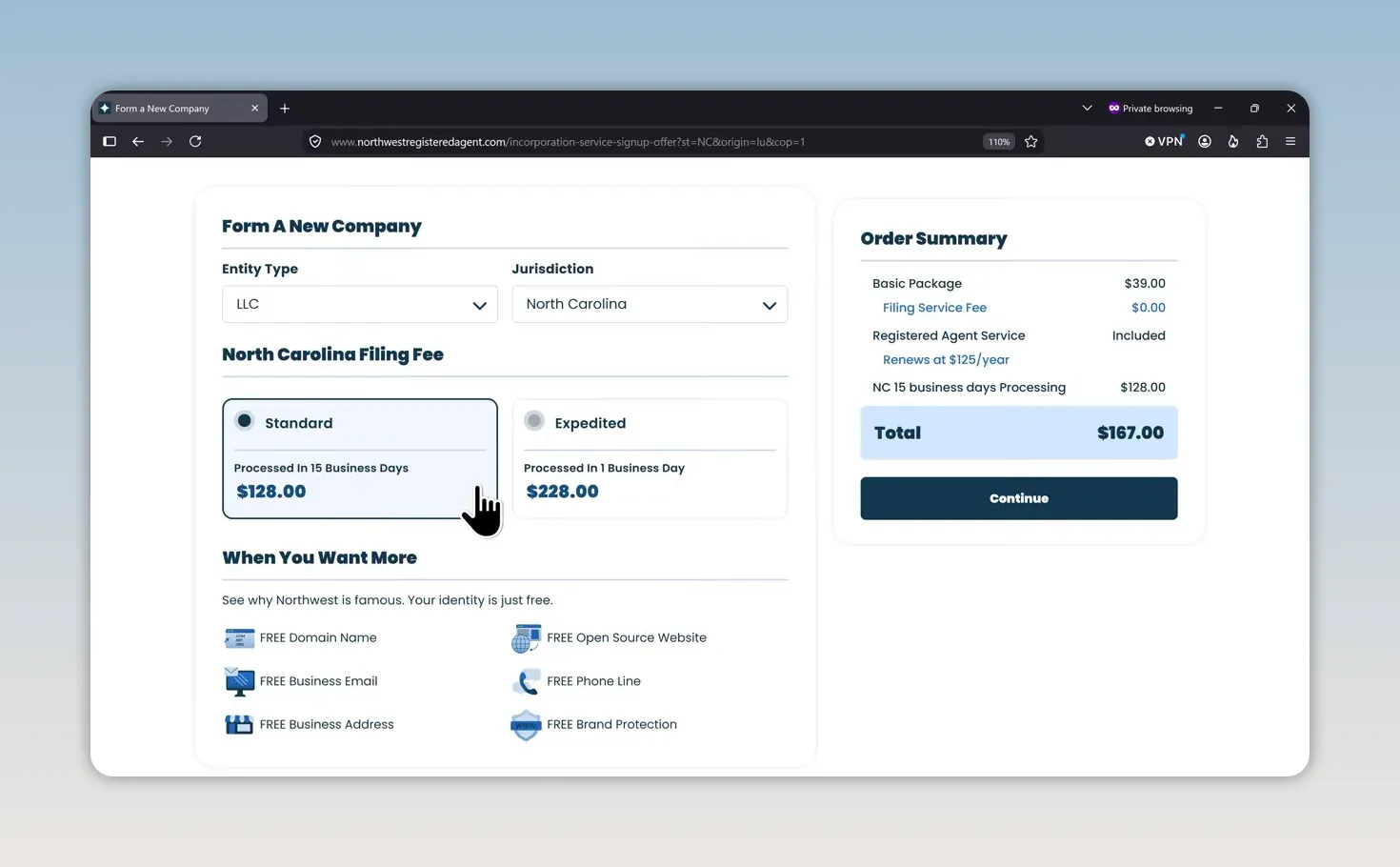
The checkout also lists included extras such as a domain name, business email, business address, an open-source website, a phone line, and brand protection. Review the terms for any extras you plan to use rather than choosing a formation service based only on the bonus list.
You will also see annual compliance included in the setup. This is a separate ongoing service that costs $100 per year plus the state report fee when Northwest handles your annual report. There is no charge for it at this initial checkout, but it is important to decide whether you want it. I’ll explain that in Step 7.
Enter your company name and decide whether to pay for EIN filing
Enter your business name and check the preview showing how it will appear on state records. Make sure the spelling and LLC designation are correct.
Next, you can choose whether Northwest should apply for your EIN, which is your business’s federal tax identification number.
- $50: EIN filing service if you have a Social Security number.
- $200: EIN filing service if you do not have a Social Security number.
- Free: Apply directly through the IRS yourself using the applicable application method.
My preference here is to pay the $50 and have Northwest handle it after approval. That is purely a convenience choice, not a required expense. If you want to keep costs down, skip the paid EIN service and complete Step 4 yourself.
Create your account and review the total
Enter your name, phone number, email address, and password. Use an email account you can access and check regularly, because this is where filing updates will go and how you will access your Northwest account.
On the payment screen, enter your payment details and billing address, then review the order carefully.
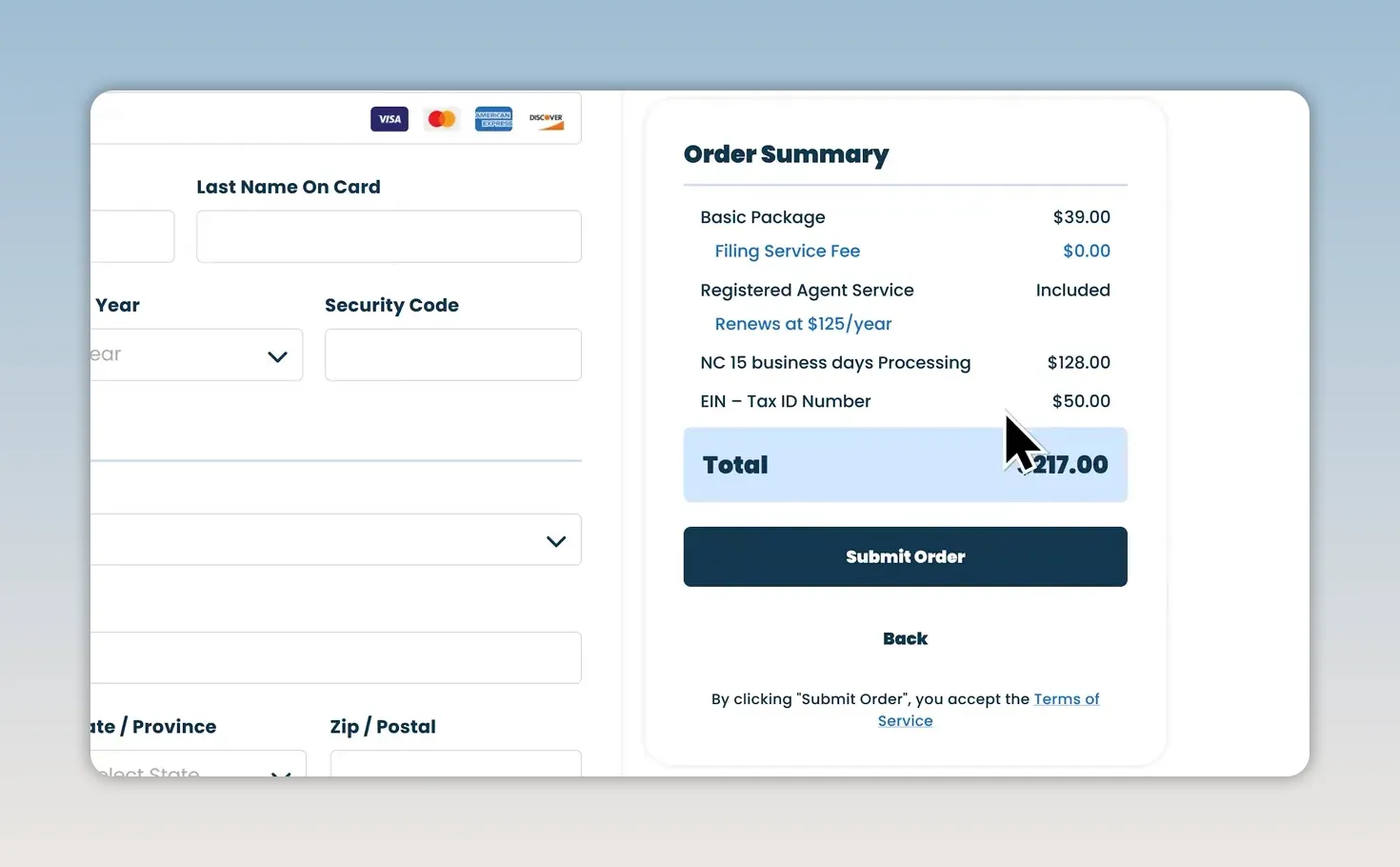
With standard processing and the $50 EIN service selected, the example total is:
- Northwest formation service: $39.
- First year of registered agent service: Included.
- North Carolina filing charges shown: $128.
- Optional EIN filing service: $50.
- Total due at checkout: $217.
Without the optional EIN service, that example total would be $167. The registered agent renewal and annual compliance service are future costs, not part of that initial total.
Finish your business details after checkout
After payment, there are still a few details to complete before Northwest files your paperwork.
First, review your addresses. The business physical and mailing addresses may default to the address provided at checkout. Both can appear in public records. If your goal is to keep your home address off the filing, select Northwest’s included address option for both fields where available.
Second, choose how the LLC will be managed.
- Member-managed: The owners run the business.
- Manager-managed: Designated managers run the business rather than all owners managing it directly.
If it is just you, or you and a partner actively running the business, member-managed is the straightforward choice.
Understand the optional add-ons
You may also see four additional services. None is necessary just to form a basic LLC, so I would skip them unless you already have a specific need.
- S corporation election: This changes how the business is taxed, not its underlying LLC structure. It may reduce certain employment taxes in appropriate circumstances, but it also brings payroll and bookkeeping responsibilities. For a brand-new business, I would revisit this with an accountant later.
- Mail forwarding: Registered agent service handles legal mail. This additional service is for regular business mail sent to Northwest’s address, which can then be scanned and sent to you.
- Trademark filing: Federal trademark registration may be worth considering as you build a brand, but it is separate from LLC formation and is not required to form the company.
- DBA: A “doing business as” name lets you operate under a name different from your LLC’s legal name. For example, Smith Ventures, LLC might use Main Street Coffee as its business name. If you are using your LLC’s own name, you may not need this service.
You can revisit these options later rather than buying them just because they appear during setup.
Save your approved formation documents
Once the state approves the filing, Northwest sends an email and makes the documents available in your account.
Download and save your filed Articles of Organization. This is the state’s official evidence that your North Carolina LLC has been formed. Keep the document and your Secretary of State identification number somewhere easy to find, because you will need them for the next steps.
Step 4: Get Your EIN
An Employer Identification Number, or EIN, is a federal tax ID for your business. Think of it as an identification number for the company rather than for you personally. It is commonly used for business banking, tax administration, and hiring employees.
If you selected Northwest’s EIN service, they handle the application after your LLC is approved.
If you prefer to do it yourself, use the official IRS EIN application page. The IRS does not charge an application fee.
For eligible applicants, the online application can take about 10 minutes, and the EIN is issued at the end of a successful application. Check the IRS eligibility requirements, especially if you do not have a Social Security number or cannot use the online application.
Wait until your LLC is approved before applying. Then save the EIN confirmation with your formation documents.
Step 5: Write Your Operating Agreement
Your operating agreement explains how your LLC works internally. It lays out:
- Who owns the business and each owner’s percentage.
- Who has authority to make decisions.
- How profits are divided.
- What happens if an owner leaves.
North Carolina does not require you to file an operating agreement with the state, and a written agreement is not required to form the LLC. Still, I would absolutely have one.
Banks often request it. For a single-owner LLC, it also helps document that the business is being operated as a separate entity rather than as an extension of your personal finances.
Northwest provides free North Carolina operating agreement templates. Choose the single-member version if you are the only owner or a multi-member version if you have partners.
Complete the agreement, sign it, and keep it with your business records. If you have partners, I recommend having an attorney review it before anyone signs. Ownership, decision-making, and exit terms are worth getting clear at the beginning.
Step 6: Open a Business Bank Account
Once you have your formation documents, EIN, and operating agreement, open a dedicated business bank account.
The rule is simple: business income goes into the business account, and business expenses come out of it.
Keeping business and personal money separate supports the distinction between you and the LLC. Mixing funds can undermine that separation and create liability problems. A separate account does not guarantee liability protection by itself, but it is an important part of operating the LLC properly.
It also makes bookkeeping much easier because your business transactions are in one place.
You can use a bank that fits your needs. If you want a starting point, here is my business bank account recommendation for beginners.
Have these documents ready:
- Your filed Articles of Organization.
- Your EIN confirmation.
- Your signed operating agreement.
Confirm the bank’s requirements before applying so you have everything it requests.
Step 7: Keep Your North Carolina LLC Active
Getting approved is not the end of the process. You also need to keep the LLC in good standing.
File your annual report by April 15
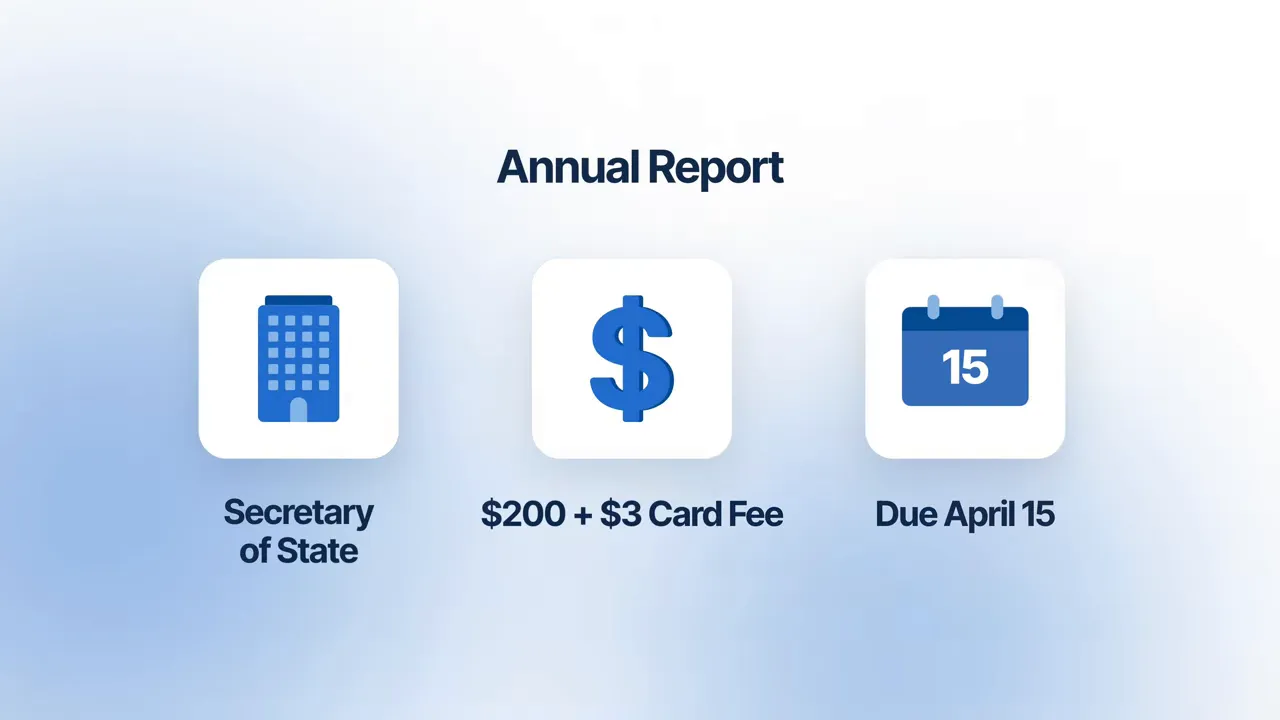
North Carolina LLCs must file an annual report with the Secretary of State. It is a short filing that confirms your business details.
- Due date: April 15 each year.
- First report: Due the year after your LLC is approved.
- Fee: $200, plus the $3 card fee shown for online filing.
The report may only take a few minutes, but it is not optional. Falling behind can lead to administrative dissolution proceedings. The process described here can begin after the report is more than 60 days late, followed by notice and an opportunity to correct the issue. Do not treat that as extra filing time.
My recommendation is to set a recurring calendar reminder for March 15. That gives you a month to take care of it before the deadline.
Decide whether to keep Northwest’s annual compliance service
Northwest’s annual compliance service is enabled by default in the formation process shown here. It is separate from registered agent service.
Here is how it works:
- About 90 days before the deadline, Northwest sends a reminder.
- A few days later, it charges the card on file.
- The charge is $100 for the service, plus the applicable state report fee.
- Northwest handles the annual report filing for you.
The reminders are free either way. The $100 service fee pays for having Northwest handle the filing.
If you know you will stay on top of the deadline, I would cancel the paid compliance service in your account and put that $100 toward something else in the business. If an annual deadline is likely to slip through the cracks, keeping it may be worthwhile.
Make that decision now, rather than waiting until a reminder or charge arrives. Also remember that registered agent service has its own $125 annual renewal after the included first year.
Check whether your business needs a license
North Carolina does not have one universal business license that covers every business. Depending on what you do, you may need specific licenses or permits.
The state’s free Small Business Advisors service can help you identify the requirements that apply to your business. Forming an LLC and getting permission to carry out a regulated activity are separate tasks.
Your North Carolina LLC Setup Checklist
By the end of this process, you should have:
- An approved LLC name and a registered agent.
- Filed Articles of Organization saved with your business records.
- An EIN and its confirmation.
- A signed operating agreement.
- A dedicated business bank account.
- A plan for filing the annual report and paying recurring fees.
- Any licenses or permits your business requires.
The goal is not to buy every service offered during checkout. It is to get the required work done, pay for convenience only where it makes sense, and build good habits from day one.
I’m not a lawyer or an accountant, so use this guide as a starting point. For questions specific to your ownership arrangement, tax situation, or licensing needs, speak with a qualified professional familiar with North Carolina businesses.


